Subscribe to The TurkEU Blog by Email

Friday, February 15, 2013

France's softened stance opens the board

Only weeks after the end of the Cypriot presidency and all kinds of interesting things are happening.

Just a few days ago, the French foreign minister stated that France is removing its opposition to opening new negotiating chapters with Turkey, and stated that “France will extend support to Turkey’s EU membership negotiations."

This is a major development because France, under former president Sarkozy, was one of the key opponents of continuing the negotiations that begun in 2005.

France now wants to open Chapter 22 - "Regional Policy and Coordination of Structural Instruments."

Add to this the positive signs in the difficult negotiations with the PKK and the potential for the presidential elections on Cyprus to change the status quo and a lot can still happen on the Turkey-EU front.

(Btw, posting this while walking to the office:)


Saturday, February 9, 2013

Turkey: EU political benchmarks 'were never given to us' | EurActiv

Interesting report from EurActiv.com: According to a high-level Turkish official in the Ministry for EU Affairs, the detailed benchmarks for what is needed to open two key negotiating chapters (pertaining to democracy and fundamental rights) were never sent to Turkey.
Burak Erdenir, deputy undersecretary at the Turkish Ministry for EU Affairs, said Ankara was never given the promised benchmark criteria that are needed to open the two controversial EU accession chapters covering justice, freedom and fundamental rights, also referred to as chapters 23 and 24.
Here's how the EU describes the process of opening chapters:
Screening – the Commission carries out a detailed examination, together with the candidate country, of each policy field (chapter), to determine how well the country is prepared. The findings by chapter are presented by the Commission to the Member States in the form of a screening report. The conclusion of this report is a recommendation of the Commission to either open negotiations directly or to require that certain conditions – opening benchmarks - should first be met.
In Turkey's case, the benchmarks are of course important since the EU's progress reports have been harsh in their criticism of the areas in question. The two chapters are not part of the eight chapters that were blocked in the 2006 Council decision.

Erdenir suggests that this is a deliberate strategy to delay the accession talks:
“You can’t ask us to complete benchmarks which were never given to us and then bash Turkey on lacking political reforms – it simply makes no sense,” Erdenir said.
I have not found any comments from inside the EU.

Turkey: EU political benchmarks 'were never given to us' | EurActiv

Sunday, January 27, 2013

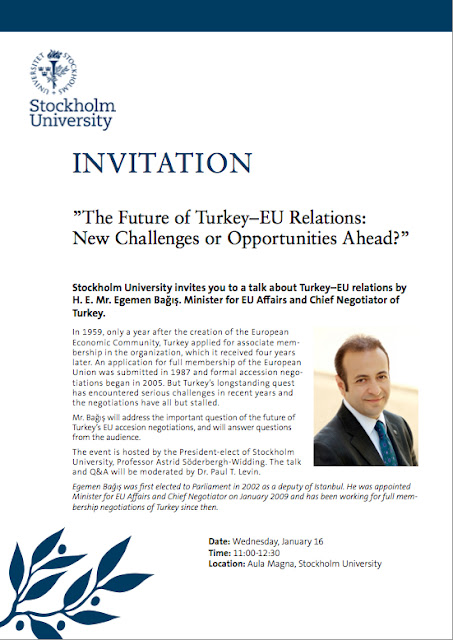
Turkey's EU minister at Stockholm University (video)


Egemen Bağış (right) and Paul Levin. Photo: Eva Dalin

Heading off to Turkey tomorrow for a week so I don't have time for a longer post. But I thought I should at least post a link to the video of the talk by Turkey's Minister for EU Affairs and chief negotiator, Egemen Bağış, at Stockholm University last week.

I introduced Mr. Bağış and moderated the Q&A, which lasted for around 45 minutes. No questions were pre-screened. There were some protests at the very end of the Q&A, which made a bit of a stir in Turkish news, but below is a link to the whole thing, unedited and in its context.

If I have time, I will comment on the content at a later time.

Enjoy!

Here is a link to an article on the Stockholm University web site, with a link to the video.

If you want the video directly, click here.

Monday, January 7, 2013

Turkey, Sweden, and Brazil form a Trilateral pact?

The foreign ministers of Turkey, Sweden, and Brazil released a statement with the title "Trilateral Solidarity for Building peace" during a meeting in Izmir on January 5.

It is somewhat unclear how much the initiative means in practice, other than serving as a recognition of the already frequent contacts between these governments and their foreign ministers. But at the least, it entails continued meetings between the three ministers, during which they will touch on relevant global topics. According to my source, it may also lead to meetings between civil servants in the foreign ministries.

Swedish foreign minister, Carl Bildt, is a longtime believer in the strategic significance of Turkey and has been working actively to strengthen relations between the two states. But this initiative was originally proposed by the magazine Monocle, which organized a round table with the three foreign ministers in New York. I suspect that the name comes from Davutoğlu, however.

Here is a link to an article in Hurriyet Daily News on the initiative.

Here is the statement on the web page of the Swedish Ministry of Foreign Affairs.

Turkey accuses EU of bigotry | EurActiv

Turkey has published its own report on the country's progress in adopting the EU aquis. According to Turkish Minister of EU Affairs, Egemen Bağış, the decision is in response to the fact that
this year's Turkey Progress Report was overshadowed by more subjective, biased, unwarranted and bigoted attitudes.
I must admit to not yet having gotten through the report (one of many unfinished projects over the winter break...) but my back channel sources tell me that the Cypriot delegation has been demanding stronger language in recent years' Progress Reports.

You can find Bağış' statement here.

And here's EurActiv's article on the issue.


Monday, November 19, 2012

Renewed talks w PKK after end of hunger strike

As good an ending to the recent hunger strike by hundreds of Kurdish prisoners in Turkey as one could have hoped for. Renewed talks.

"International academic live talk show"?

Check out Crosstalks - a spanking new live and interactive "academic talk show". It is a joint project between Stockholm University and the Royal Institute of Technology (KTH):
Crosstalks is a high quality and new form of international academic live talk show. Two of Sweden’s leading universities – KTH and Stockholm University – are working together to highlight cutting-edge content from the academic, business and cultural life. The website allows people from all over the world to comment and interact with each other based on content and program participants. It is always possible to start an interesting discussion online and the content is always available.
The premiere tomorrow features three topics: "How to save capitalism", "The battle for entrepreneurs", and "How to save the world." (I got the answer to all three but tune in to find out for yourselves.)

This has nothing to do with Turkey but you could change that. At the website you can suggest new topics and speakers. Go ahead!

Thursday, November 15, 2012

Erdoğan proposes a Lira-zone


From the Atlantic Sentinel:
Turkish prime minister Recep Tayyip Erdoğan urged the European Union on Tuesday to grant his nation membership by 2023 and suggested that it could set up a currency union of its own instead of joining the euro.
The talk of a currency union is surely more of a dig against an economically weakened EU than a serious proposal. Talking tough to the Union plays well in Turkey now, and a deadline is probably popular in a country that has been waiting for membership since 1959.

I suspect that this is domestic politics more than anything else. With local and Presidential elections coming up in 2014, expect more of it.

Sunday, October 28, 2012

Pamuk on Europe

Lovely short piece in the Guardian by Orhan Pamuk, reflecting on Turkey and Europe.

In it, he reminisces nostalgically about the time when people in Turkey and elsewhere were interested in the Turkish EU bid. Nowadays however, he concludes,

as Europe struggles with the euro crisis, and EU expansion has slowed down, very few of us still bother to think and talk about these issues. And unfortunately, the positive interest surrounding Turkey's possible future membership has also waned. This is partly because freedom of thought remains regrettably underdeveloped in Turkey. But the biggest reason is undoubtedly the large influx of Muslim migrants from north Africa and Asia into Europe that, in the eyes of many Europeans, has cast a dark shadow of doubt and fear over the idea of a predominantly Muslim country joining the union. 
It is clear that this fear is leading Europe to put up walls at its borders, and to gradually turn away from the world. As the slogan of liberté, égalité, fraternité is slowly forgotten, Europe will sadly turn into an increasingly conservative place dominated by religious and ethnic identities.
Ping your podcast