Subscribe to The TurkEU Blog by Email

Wednesday, August 20, 2014

Seminarium: Turkey - opportunities and risks on the road ahead

Seminarium: Turkey - opportunities and risks on the road ahead


I syfte att ge stöd åt svenska företags bedömningar om den turkiska marknaden och genom att belysa både utmaningar och de stora möjligheter som Turkiet erbjuder, anordnar Institutet för Turkietstudier vid Stockholms universitet (SUITS) och Business Sweden ett gemensamt halvdagsseminarium i samarbete med Utrikesdepartementet.
Turkiets ekonomiska tillväxt och utveckling det senaste decenniet har rönt stor uppmärksamhet. Turkiet förhandlar om medlemskap i EU sedan 2005 och ingår i en tullunion med EU sedan 1996. Landet har vuxit till en ekonomisk motor i regionen och blivit alltmer intressant som investeringsmål och marknad för svenska företag. 2013 tecknade Sverige och Turkiet ett strategiskt partnerskapsavtal.
På senare tid har dock Turkiets sårbarhet blottats – både politiskt och ekonomiskt – och landet kritiserats för korruption och minskad pressfrihet. Turkiets vision om att vara den tionde största ekonomin i världen år 2023 fordrar omfattande strukturreformer.
Mycket har hänt både i Turkiet och dess närområde under de senaste åren. Det finns anledning att diskutera bland annat justerade handelspolitiska strategier och förväntningar, politisk riskbedömning, korruption samt stabiliteten i Turkiets grannskap.
Datum: Måndag 1 september
Tid: Kl 13.00-17.30 (registeringen startar kl 12.30)
Plats: Regeringskansliet (Näringsdepartementet), Mäster Samuelsgatan 70, Stockholm, möteslokal Aulan
Deltagaravgift: 950 SEK
Språk: Engelska, frågor kan ställas på svenska 
Välkommen på en kvalificerad genomlysning av Turkiets aktuella politik och vad den betyder för bedömningarna om marknadsutveckling och affärsmöjligheter.
Business Sweden i samarbete med SUITS och Utrikesdepartementet.
- See more at: http://www.business-sweden.se/Om-oss/Seminarier-och-events/EventsSeminarier/Seminarium-Turkey---opportunities-and-risks-on-the-road-ahead/#sthash.trH10BXB.dpuf

Friday, January 17, 2014

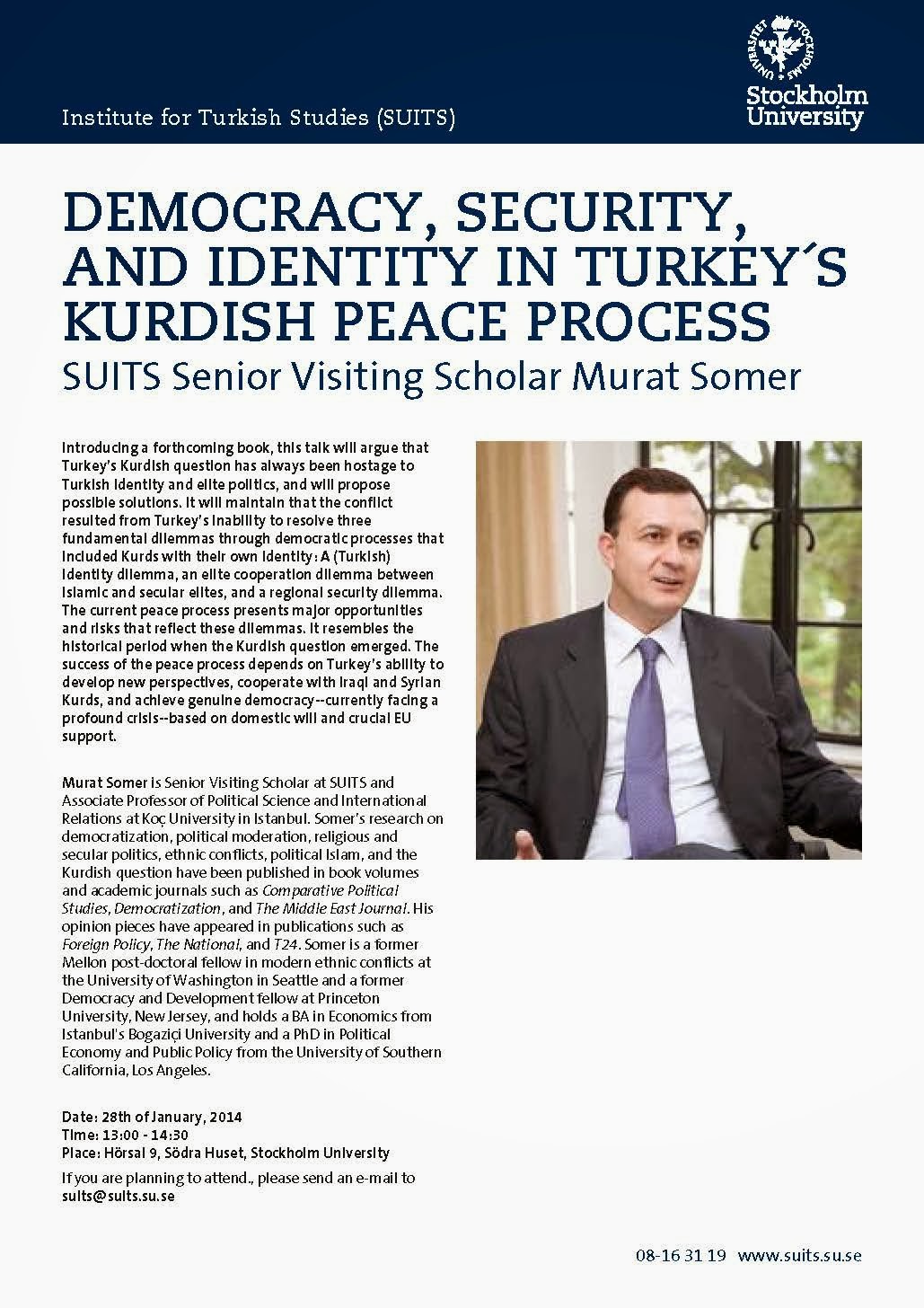
SUITS Senior Scholar Murat Somer on the Kurdish Settlement Process (and other things)

Murat Somer, Senior Visiting Scholar at The Stockholm University Institute for Turkish Studies, has been busy lately. He has a new article in Foreign Policy magazine on current developments in Turkey and what the EU could do to move things in the right direction. Read it here.


Murat also has a forthcoming book on the Kurdish issue in Turkey, which addresses the challenge of reformulating "Turkishness" in the Turkish constitution, among other topics. Alas, the book will be in Turkish, but if you happen to be in Stockholm on the 28th of January you can come hear the author talk about his book and offer his analysis of the ongoing attempt to settle the conflict between the government and the PKK. See the flyer and link below.


Wednesday, December 4, 2013

Turkish Wave in TV Drama - Institute for Turkish Studies

Do Turkish soap operas have an impact on gender relations in the Middle East and North Africa? What did Swedish Television do with four-minute long crying scenes when they aired "The End" on primetime? These and many more questions were answered by the panelists at the Turkish Wave in TV Drama - Institute for Turkish Studies Follow the link to see a film from the event!

Tuesday, November 26, 2013

Debreafing of Returning Ambassador to Turkey - Institute for Turkish Studies

Join us at the Stockholm University Institue for Turkish Studies (SUITS) for a "Debreafing" of the returning Swedish Ambassador to Turkey, H.E. Ambassador Håkan Åkesson. The ambassador will reflect on his time in Turkey and take questions.
Debriefing on Turkey - Institute for Turkish Studies

Wednesday, October 30, 2013

Media coverage of our event: The Global Turkish Wave in TV Drama

Last Friday, the Institute for Turkish Studies held a well-attended panel conversation about the global impact of Turkish TV dramas.

We held the event at what I believe is the oldest movie theatre in Stockholm, Biograf Zita. The panelists included top TV producer Kerem Catay, media scholars Melis Behlil (Kadir Has U. and Affiliated Researcher at SUITS) and Eylem Yanardagoglu (Kadir Has U.), as well as the Swedish distributor of many of the Turkish shows - Fredrik af Malmborg - and Magdalena Löfström from Swedish Television (SVT), who is responsible for the Turkish market and for the decision to air the Turkish show Son (The End, or Lögnen, as it was called in Sweden) on prime time. Yours truly served as moderator.


The event was covered by several Swedish and Turkish media, including the large Swedish daily Svenska Dagbladet and the news show Kulturnytt on Swedish Radio P1. Below a list of links to some of the coverage in Turkish media.

http://www.hurriyetdailynews.com/turkish-dramas-discussed-in-sweden.aspx?pageID=238&nID=56984&NewsCatID=381

http://www.haberler.com/turk-dizileri-isvec-te-tartisildi-5219538-haberi/
http://www.isvecpostasi.com/haber/380/ortadogu-da-turk-dizileri-cinsiyet-rollerini-degistiriyor.html


Tuesday, August 20, 2013

The EU, the Kurdish question, and democratic reforms

Arboga - a small Swedish town an hour and half outside Stockholm is passing outside the train windows. I am on my way back from having commented on a draft Doctoral thesis on Kurdish ethnopolitical mobilization in Turkey, at Örebro University.

In Swedish, the discussant is called the "opponent" but I hope that I wasn't very hostile. In fact, there were a lot of interesting material in the thesis that got me thinking.

Among other things, the interviews that the author had conducted with pro-kurdish elite activists in parties, media organizations, unions and other civil society organizations, showed how important the EU has been for the Turkish reform process. Most of the interviewees appeared to credit the EU for the (limited but yet) opening up of political space that most of the respondents had noticed by 2005.

But they also faulted the union for its lack of involvement in the question of minority rights and the situation of Kurds in the years before 2008, when the study ended. And the danger is clear that this is set to continue.

The lingering Eurozone troubles, the problematic aftermath of the Gezi Park demonstrations, and now the interpretation given to the Egyptian crisis by the dominant AKP leaders, all of these are reason for concern regarding the EU's continued "normative power"to propel a continued Turkish reform process.

Some of this is the AKP leadership's own fault (especially with respect to the state of the independence of media and the harsh response to the Gezi protests). Some of it - arguably the tragic developments in Egypt and Syria (pace the conspiratorial interpretations emanating from Ankara) - is largely out of the hands of both the EU and Turkey.

But the almost impressive mismanagement in the EU's response to the Great Recession can be blamed on no one else. And the decreasing credibility with which the union has been able to present itself as a fair adjudicator of developments in Turkey has to do with the fact that it has opened itself up to the accusation of having hidden culturalist or religious standards when judging Turkey. And the same reason undermines the credibility with the which it can put forth a full membership offer as an incentive for reform.

That's a real shame. The important post-Gezi lesson for the EU that I draw from the thesis I just read, is that failure to credibly engage is not a strategy that is likely to boost democratic reforms in Turkey.

Tuesday, June 25, 2013

Interviewed by "Zaman" newspaper about the Gezi protests (in Turkish)


The Turkish daily newspaper Zaman published an interview with me today. In it, I address questions about the consequences of the Gezi Park protests, about Prime Minister Erdoğan, and about Turkey's relations with the EU. You can find the interview here (note that it is in Turkish).

Sunday, June 16, 2013

On my way to Istanbul...

On my way to the airport and Istanbul. I'm going there to take part in a workshop organized by the Swedish Research Institute in Istanbul, which is located in the lovely "Swedish palace" on Istiklal street, which ends in Taksim square. 

My flight is schedules to arrive at 4:15 pm. That would be precisely 15 minutes after the planned start of two major rallies to be held simultaneously in the city: one in support of the AKP and the other in support of the Gezi Park demonstrators. Let's hope for the best. 

To be continued. 

Saturday, June 1, 2013

Angry Protests Grow in Turkey as Police Continue Crackdown | NYTimes.com

The NYT reports:
Violent protests against the government of Prime Minister Recep Tayyip Erdogan engulfed this city on Saturday, as thousands of demonstrators took to the streets and alleyways in a second day of civil unrest and faced the tear gas and water cannons of a harsh police crackdown.
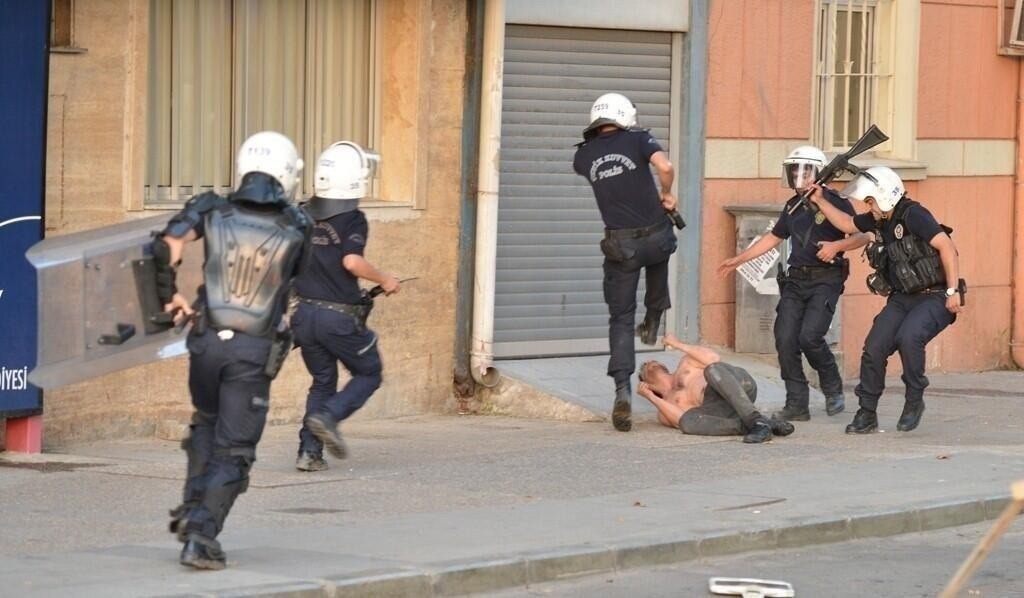
The police has now pulled out of Taksim Square and let protestors in. Prime Minister Erdoğan has admitted that the security forces made errors, especially with regard to their use of tear gas. Judging from the picture below, their errors do not exactly seem limited to the use of tear gas...

Picture courtesy of http://occupygezipics.tumblr.com/

Angry Protests Grow in Turkey as Police Continue Crackdown - NYTimes.com

Friday, March 22, 2013

Israel + Turkey = true (again)

Cease fire with PKK and now making friends with Israel - Erdoğan is on a roll.

http://www.hurriyetdailynews.com/israel-pm-apologized-to-turkey-pm-over-flotilla-deaths.aspx?pageID=238&nID=43445&NewsCatID=352

Thursday, March 21, 2013

Kurd rebel leader orders fighters to cease fighting, leave Turkey | Reuters

I am afraid that I don't have time for a longer post on this arguably momentous day since I have to finish a conference paper. But Reuters has a sober report on today's call, by the imprisoned PKK leader Abdullah Öcalan, for a withdrawal of PKK fighters beyond Turkey's borders and on the challenges that lie ahead. It is worth reading.

Since I am naturally inclined to be naïvely optimistic, I would qualify the healthy skepticism of the Reuters piece by emphasizing that what is happening today and with the ongoing peace process is something truly extraordinary. There are no guarantees and set-backs are entirely possible (how will Turkish nationalists react to seeing a sea of PKK flags but no Turkish flags at the gatherings, for example?), but have we ever been this close to a lasting resolution of the Kurdish conflict?

Let us stop and acknowledge the significance of the moment before adding the necessary caveats.

Below are some excerpts from Öcalan's letter, which was read to more than a million listeners in Diyarbakır today, courtesy of Hürriyet Daily News:

“We are at a point today that guns will be silenced and thoughts will speak. It is time for armed elements to move outside [Turkey’s] borders. This is not an ending but a new beginning”

“Our fight has not been against any race, religion or groups. Our fight has been against all kinds of pressure and oppression. Today we are waking up to a new Middle East, new Turkey and a new future” 
“Today a new era is beginning. A door has been opened from armed struggle to democratic struggle” 
“The Middle East and Middle Asia are looking for a new order. A new model is a necessity, like bread and water”' 
“It is time for unity. Turks and Kurds fought together in Çanakkale [during World War I], and launched the Turkish Parliament together in 1920” 
“Despite all the mistakes done in the past 90 years, we are trying to build a model that embraces all oppressed people, classes and cultures” 
“The basis of the new struggle is ideas, ideology and democratic politics”


Kurd rebel leader orders fighters to cease fighting, leave Turkey | Reuters

Sunday, March 17, 2013

Interview on Radio Sweden

On Thursday, I did a 10-minute interview with Radio Sweden, which aired as their Friday interview. I spoke with Radio Sweden's Kris Boswell about the historical State visit to Sweden by President Gül - the first ever - and about why an institute for Turkish studies is needed.

http://sverigesradio.se/sida/artikel.aspx?programid=2054&artikel=5475482

Wednesday, March 13, 2013

Institute for Turkish Studies Inaugurated! (video)

The Stockholm University Institute for Turkish Studies was inaugurated yesterday, in the presence of the Heads of State of both Turkey and the European Union!

See the video from the inauguration, with speeches by the Turkish and Swedish foreign ministers, the Vice-Chancellor of Stockholm University (and yours truly) here:


Read more on Stockholm University's home page.

Friday, February 15, 2013

France's softened stance opens the board

Only weeks after the end of the Cypriot presidency and all kinds of interesting things are happening.

Just a few days ago, the French foreign minister stated that France is removing its opposition to opening new negotiating chapters with Turkey, and stated that “France will extend support to Turkey’s EU membership negotiations."

This is a major development because France, under former president Sarkozy, was one of the key opponents of continuing the negotiations that begun in 2005.

France now wants to open Chapter 22 - "Regional Policy and Coordination of Structural Instruments."

Add to this the positive signs in the difficult negotiations with the PKK and the potential for the presidential elections on Cyprus to change the status quo and a lot can still happen on the Turkey-EU front.

(Btw, posting this while walking to the office:)


Saturday, February 9, 2013

Turkey: EU political benchmarks 'were never given to us' | EurActiv

Interesting report from EurActiv.com: According to a high-level Turkish official in the Ministry for EU Affairs, the detailed benchmarks for what is needed to open two key negotiating chapters (pertaining to democracy and fundamental rights) were never sent to Turkey.
Burak Erdenir, deputy undersecretary at the Turkish Ministry for EU Affairs, said Ankara was never given the promised benchmark criteria that are needed to open the two controversial EU accession chapters covering justice, freedom and fundamental rights, also referred to as chapters 23 and 24.
Here's how the EU describes the process of opening chapters:
Screening – the Commission carries out a detailed examination, together with the candidate country, of each policy field (chapter), to determine how well the country is prepared. The findings by chapter are presented by the Commission to the Member States in the form of a screening report. The conclusion of this report is a recommendation of the Commission to either open negotiations directly or to require that certain conditions – opening benchmarks - should first be met.
In Turkey's case, the benchmarks are of course important since the EU's progress reports have been harsh in their criticism of the areas in question. The two chapters are not part of the eight chapters that were blocked in the 2006 Council decision.

Erdenir suggests that this is a deliberate strategy to delay the accession talks:
“You can’t ask us to complete benchmarks which were never given to us and then bash Turkey on lacking political reforms – it simply makes no sense,” Erdenir said.
I have not found any comments from inside the EU.

Turkey: EU political benchmarks 'were never given to us' | EurActiv
Ping your podcast