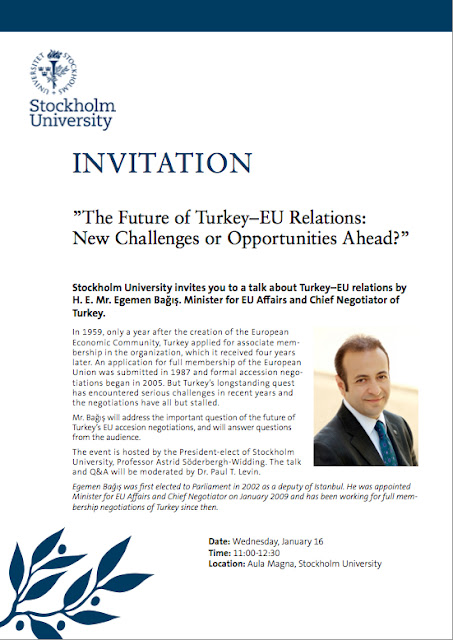

Tuesday, January 15, 2013


Monday, January 7, 2013
Turkey, Sweden, and Brazil form a Trilateral pact?
The foreign ministers of Turkey, Sweden, and Brazil released a statement with the title "Trilateral Solidarity for Building peace" during a meeting in Izmir on January 5.
It is somewhat unclear how much the initiative means in practice, other than serving as a recognition of the already frequent contacts between these governments and their foreign ministers. But at the least, it entails continued meetings between the three ministers, during which they will touch on relevant global topics. According to my source, it may also lead to meetings between civil servants in the foreign ministries.
Swedish foreign minister, Carl Bildt, is a longtime believer in the strategic significance of Turkey and has been working actively to strengthen relations between the two states. But this initiative was originally proposed by the magazine Monocle, which organized a round table with the three foreign ministers in New York. I suspect that the name comes from Davutoğlu, however.
Here is a link to an article in Hurriyet Daily News on the initiative.
Here is the statement on the web page of the Swedish Ministry of Foreign Affairs.
It is somewhat unclear how much the initiative means in practice, other than serving as a recognition of the already frequent contacts between these governments and their foreign ministers. But at the least, it entails continued meetings between the three ministers, during which they will touch on relevant global topics. According to my source, it may also lead to meetings between civil servants in the foreign ministries.
Swedish foreign minister, Carl Bildt, is a longtime believer in the strategic significance of Turkey and has been working actively to strengthen relations between the two states. But this initiative was originally proposed by the magazine Monocle, which organized a round table with the three foreign ministers in New York. I suspect that the name comes from Davutoğlu, however.
Here is a link to an article in Hurriyet Daily News on the initiative.
Here is the statement on the web page of the Swedish Ministry of Foreign Affairs.
Turkey accuses EU of bigotry | EurActiv
Turkey has published its own report on the country's progress in adopting the EU aquis. According to Turkish Minister of EU Affairs, Egemen Bağış, the decision is in response to the fact that
You can find Bağış' statement here.
And here's EurActiv's article on the issue.
this year's Turkey Progress Report was overshadowed by more subjective, biased, unwarranted and bigoted attitudes.I must admit to not yet having gotten through the report (one of many unfinished projects over the winter break...) but my back channel sources tell me that the Cypriot delegation has been demanding stronger language in recent years' Progress Reports.
You can find Bağış' statement here.
And here's EurActiv's article on the issue.
Monday, November 19, 2012
Renewed talks w PKK after end of hunger strike
As good an ending to the recent hunger strike by hundreds of Kurdish prisoners in Turkey as one could have hoped for. Renewed talks.
"International academic live talk show"?
Check out Crosstalks - a spanking new live and interactive "academic talk show". It is a joint project between Stockholm University and the Royal Institute of Technology (KTH):
This has nothing to do with Turkey but you could change that. At the website you can suggest new topics and speakers. Go ahead!
Crosstalks is a high quality and new form of international academic live talk show. Two of Sweden’s leading universities – KTH and Stockholm University – are working together to highlight cutting-edge content from the academic, business and cultural life. The website allows people from all over the world to comment and interact with each other based on content and program participants. It is always possible to start an interesting discussion online and the content is always available.The premiere tomorrow features three topics: "How to save capitalism", "The battle for entrepreneurs", and "How to save the world." (I got the answer to all three but tune in to find out for yourselves.)
This has nothing to do with Turkey but you could change that. At the website you can suggest new topics and speakers. Go ahead!
Thursday, November 15, 2012
Erdoğan proposes a Lira-zone
From the Atlantic Sentinel:
Turkish prime minister Recep Tayyip Erdoğan urged the European Union on Tuesday to grant his nation membership by 2023 and suggested that it could set up a currency union of its own instead of joining the euro.The talk of a currency union is surely more of a dig against an economically weakened EU than a serious proposal. Talking tough to the Union plays well in Turkey now, and a deadline is probably popular in a country that has been waiting for membership since 1959.
I suspect that this is domestic politics more than anything else. With local and Presidential elections coming up in 2014, expect more of it.
Sunday, October 28, 2012
Pamuk on Europe
Lovely short piece in the Guardian by Orhan Pamuk, reflecting on Turkey and Europe.
In it, he reminisces nostalgically about the time when people in Turkey and elsewhere were interested in the Turkish EU bid. Nowadays however, he concludes,
In it, he reminisces nostalgically about the time when people in Turkey and elsewhere were interested in the Turkish EU bid. Nowadays however, he concludes,
as Europe struggles with the euro crisis, and EU expansion has slowed down, very few of us still bother to think and talk about these issues. And unfortunately, the positive interest surrounding Turkey's possible future membership has also waned. This is partly because freedom of thought remains regrettably underdeveloped in Turkey. But the biggest reason is undoubtedly the large influx of Muslim migrants from north Africa and Asia into Europe that, in the eyes of many Europeans, has cast a dark shadow of doubt and fear over the idea of a predominantly Muslim country joining the union.
It is clear that this fear is leading Europe to put up walls at its borders, and to gradually turn away from the world. As the slogan of liberté, égalité, fraternité is slowly forgotten, Europe will sadly turn into an increasingly conservative place dominated by religious and ethnic identities.
Friday, October 5, 2012
Is a Syrian-Turkish war likely?
So we have cross-border shelling on the Turkey-Syrian border, and now (just in) a second round of retaliatory shelling by Turkish forces. Among other things, the incident shows the inherent risks of a Syrian civil war in terms of the potential for a spreading of the conflict.
We could conceivably see a "hotter" Turkey-Syrian conflict erupting, but also the regionalization of such a conflict, with Iran backing the Syrian regime and Turkey, Saudi Arabia, and Qatar ganging up against Assad. And with the Iranian regime under severe internal stress over deflation, a foreign policy distraction might come in handy. Turkey, in turn, is of course a Nato member and Russia and China have come down in support of Assad against outside interference.
But I hope and think that the Director of (the liberal Turkish think tank) TESEV's Foreign Policy Programme, Sabiha Gündogar, is right:
In other words, my hunch is that the current incident is not likely to escalate further. However, history - the Syrian downing aircraft and attack on a refugee camp on Turkish soil - shows that these tensions are lasting. And the continued Turkish support for the Free Syrian Army and likely Syrian support for the PKK, along with the continued stream of refugees from Syria into Turkey (many of whom one must assume return to Syria to fight the regime that forced them to flee) suggests that there will be plenty more opportunities to test the restraints of the leadership of the two regimes in the weeks and months to come.
We could conceivably see a "hotter" Turkey-Syrian conflict erupting, but also the regionalization of such a conflict, with Iran backing the Syrian regime and Turkey, Saudi Arabia, and Qatar ganging up against Assad. And with the Iranian regime under severe internal stress over deflation, a foreign policy distraction might come in handy. Turkey, in turn, is of course a Nato member and Russia and China have come down in support of Assad against outside interference.
But I hope and think that the Director of (the liberal Turkish think tank) TESEV's Foreign Policy Programme, Sabiha Gündogar, is right:
No matter what people are saying in the press, Turkey has not arrived at the point of discussing military action against Syria and officials are working to avoid us from ever getting to that point. (Quoted in Europe Online Magazine.)And the Syrian regime is throwing water on the fire. The BBC:
Syria said it was looking into the origin of the cross-border shelling that hit Akcakale.
Information Minister Omran Zoabi added: "Syria offers its sincere condolences to the families of the victims and to our friends the Turkish people."
In other words, my hunch is that the current incident is not likely to escalate further. However, history - the Syrian downing aircraft and attack on a refugee camp on Turkish soil - shows that these tensions are lasting. And the continued Turkish support for the Free Syrian Army and likely Syrian support for the PKK, along with the continued stream of refugees from Syria into Turkey (many of whom one must assume return to Syria to fight the regime that forced them to flee) suggests that there will be plenty more opportunities to test the restraints of the leadership of the two regimes in the weeks and months to come.
Wednesday, September 12, 2012
Heading for the Pan-European Conference on EU Politics
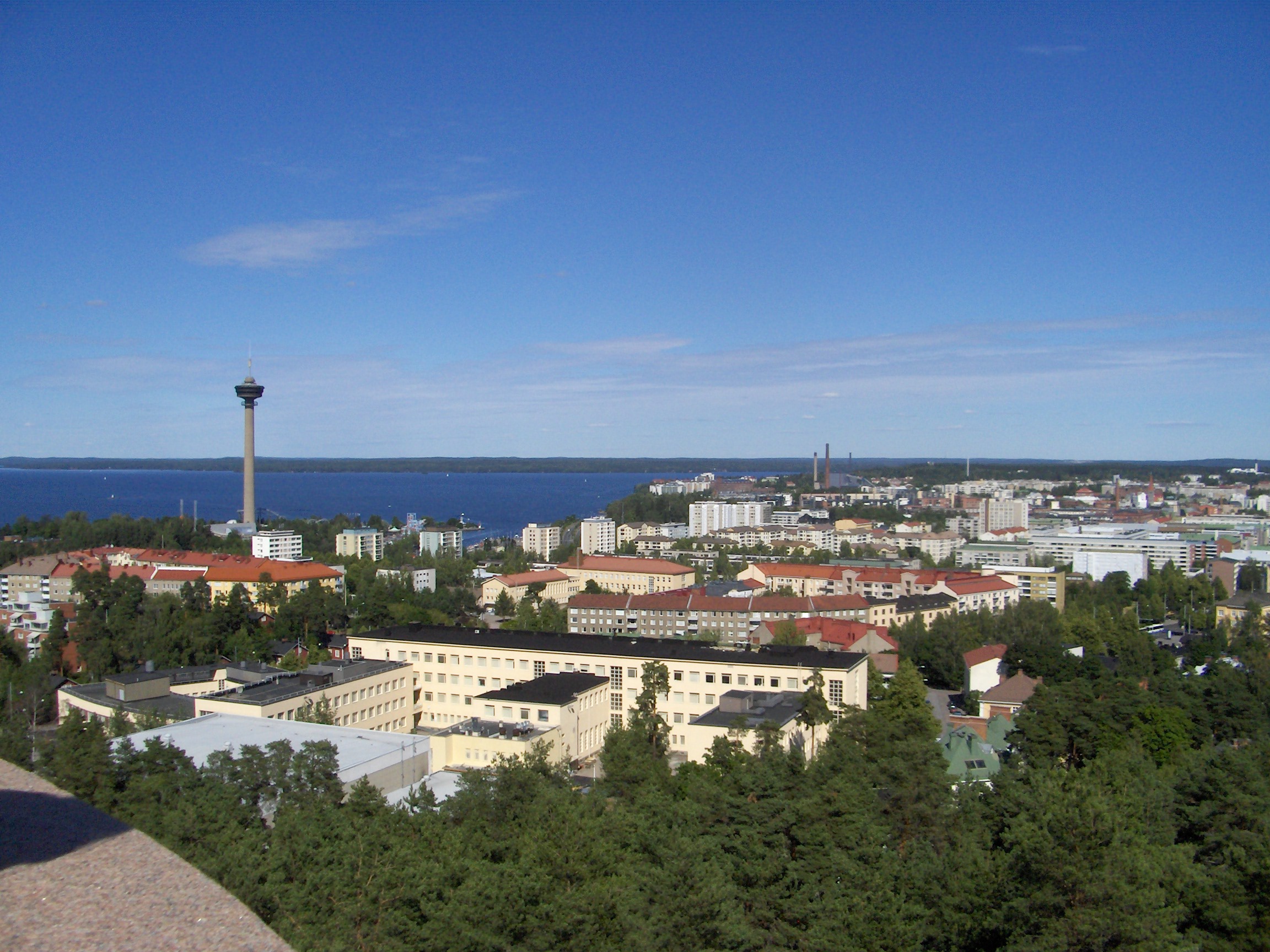
I'm currently at Arlanda Airport on my way to Tampere, a small city in central/southern Finland. I will be attending the Sixth Pan-European Conference on EU Politics organized by the European Consortium of Political Research.

I will be chairing a panel on Turkey-EU relations with papers that look at whatever happened to "normative power Europe" - or the normative influence that an attractive and dynamic EU used to have on applicant states such as Turkey. Helene Sjursen will be our discussant.
My own paper for the panel builds on the the research that I did for my book, and goes on to pontificate about the possible effects of the current Eurozone crisis for Turkey's membership bid. The panel will be the first research output from the Swedish Turkey Network that I am currently coordinating, since all the panelists are members of the network and the project got started thanks to it.
Thursday, August 30, 2012
Turks to European Union: No, Thanks | WSJ blog
The German/Turkish think tank Tavak (the Turkish European Foundation for Education and Scientific Studies) on Tuesday published the results of a poll on attitudes in Turkey toward EU membership. The poll was conducted in June. I knew that the numbers would be low, but I was surprised by how low.
According to the poll, 17% of Turks now support membership in the EU! That is down from 34% last year, which was already extremely low. And it is down from some 70% back before the negotiations begun.
Turks to European Union: No, Thanks - Emerging Europe Real Time - WSJ
According to the poll, 17% of Turks now support membership in the EU! That is down from 34% last year, which was already extremely low. And it is down from some 70% back before the negotiations begun.
Turks to European Union: No, Thanks - Emerging Europe Real Time - WSJ
Subscribe to:
Posts (Atom)