Subscribe to The TurkEU Blog by Email
Showing posts with label "Turkey and the European Union". Show all posts

Tuesday, October 11, 2011

For Europe, a Bridge Too Far to Turkey | NYTimes.com

I never blogged about this NYT article by John Vinocur, though I spotted it a little over a week ago. Perhaps because it rather annoyed me. In fact, I am disturbed by the very opening sentence:
There was always, at least for its critics, something preposterous about the idea of Turkey entering the European Union.
It meant, in their eyes, Europe literally extending its frontiers to the borders of Iran, Syria and Iraq, and the E.U. adding to its membership a predominantly Muslim country whose population would soon give it the biggest number of seats in the European Parliament. 
Sure, Vinocur is just conveying what Turkey's critics have been saying, but he doesn't seem very eager to examine these assumptions critically.

And with that skeptical opening, Turkey's "turning away" from the EU becomes quite a natural return to an equilibrium:
Turkey’s new stance gives Europe (with Germany and France opposing full Turkish membership) a respectable alibi and respite from an issue it cannot easily solve. But in the process, the door closes on the goal of integrating Turkey into a European-led geopolitical and economic order.
Here, Vinocur does sound vaguely critical, but then, apparently, the blame can be placed rather easily in one corner:
it is the Turks who are forcing the E.U. to turn away from its candidacy.
Given a) that the idea of Turkish EU membership was apparently always preposterous, b) that this is now prospect is now apparently dead, and c) that it is apparently only Turkey's fault that this is so, Vinocur continues:
“The majority of Europe welcomes the moment, thinking, ‘Great, the Turkey thing is off the table,”’ said a Brussels official whose country backs Turkish entry. He added, “We think Turkey is worth it, and that they’re a real risk if they sail off into the distance.”
 All the same, a new distance has unspoken pluses.
 The apocalyptic notion of Europe being overrun by Turkish Muslims, brandished by right-wing populists like Geert Wilders of the Netherlands — Turkey’s rapidly growing population is approaching 80 million — is deflated as a hysteria-making political argument.
OK, that sounds good. The right-wing populist hysteria is proven wrong. But wait a minute - why? Well, as far as I can tell from the piece, not primarily because they were wrong about their analysis of what would happen if Turkey joined the EU. Their apocalyptic visions won't come true because Turkey won't join the EU! Vinocur is (perhaps unwittingly) pretty much embracing the right-wing argument, or at the very least not challenging it.

Admittedly, I am not really doing Vinocur justice, so you should read the piece for yourselves. It has more going for it that I am letting on and there's good reason to be critical of Erdoğan's administration in many respects. If nothing else, the article is worth reading because it is indicative of the emerging consensus around an increasingly pessimistic view of Turkey's EU membership prospects and around the "going East" narrative.

I also understand that it is hard to write sophisticated and nuanced analyses under the kind of time-pressure that correspondents face (but the same goes for bloggers who have full time jobs so I guess that would excuse my one-sided reading of the piece).

Regardless, I can't help but be annoyed. Some historical perspective on the issue would serve Vinocur well.

For Europe, a Bridge Too Far to Turkey - NYTimes.com

Friday, September 9, 2011

Turkish leader concerned about Islamophobia in Europe | RT

(Almost) all my diverse research foci converge when Russia Today (RT) reports Abdullah Gül's remarks about the increasing racism and Islamophobia in Europe:
The Turkish leader noted that “increasing ethnic, cultural and religious tensions can result in tensions and division in society,” but it is the state that must control these processes.

“The task of the state is to secure for all its citizens, regardless of religion, language and race, equal constitutional rights and…equal opportunities,” Abdullah Gul said.
One can, of course, point out that making remarks like these while the Turkish military is embarked on a campaign against Kurdish insurgents in Eastern Anatolia invites accusations of throwing rocks while living in a glass house.

But from the Turkish perspective, the same can be said for criticism against Turkish discrimination of Kurds, coming from EU member states in which ethnic Turks and other minority groups face systematic discrimination. And given the large number of Turks living in the EU, racism and Islamophobia that targets these exile communities are legitimate concerns for the Turkish state.

Take Sweden, where I live, as an example. A wonderful country in most ways, which treats newly arrived immigrants better than most other countries, with subsidized entry-level jobs, paid for Swedish language education etc. Still, experimental research shows that even here immigrants are severely discriminated against.

One meta-study (source in Swedish) of experimental research on discrimination on the job and housing markets, reported the following findings: CVs sent by persons with Arabic-sounding names receive between 50% to 88% fewer responses from employers than identical CVs with traditional Swedish names. There were similar results on the very tough Swedish housing market (50-60%). And my hunch is that even these shockingly high numbers hide the true extent of discrimination given the importance of informal contacts in getting both jobs and rental housing in Sweden.

As for the recent rise in Islamophobia, the last chapter of my book examines the increasingly hostile - and, from the far right, Islamophobic - rhetoric evident in the European Parliament in recent years.
The point is: Gül has a point.

Increasing Islamophobia in Europe dangerous trend – Turkish leader — RT

Monday, June 20, 2011

Rädslan för Turkiet - Metropol 93,8 | Sveriges Radio

From my eyebrow-raising performance on Swedish radio last week. They took three pictures after the interview and I thought we had a consensus on which picture NOT to use. Apparently not so...


Rädslan för Turkiet - Metropol 93,8 | Sveriges Radio

Monday, June 13, 2011

My book out today!

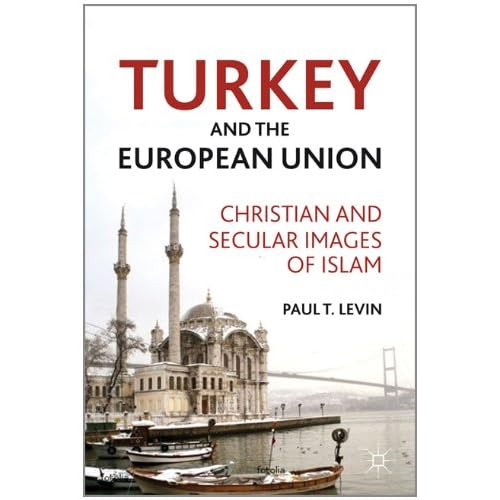
My book (Turkey and the European Union: Christian and Secular Images of Islam. Palgrave Macmillan: NY) was scheduled to come out on June 21 but Palgrave appears to have been working overtime because I received my copies today, and my university library did so, too. So I guess I'm celebrating the book-release tonight by baking a batch of sourdough bread!

For my Swedish audience, the book is available to order from Bokus.

Monday, February 14, 2011

My book now on Amazon with reviews

Turkey and the European Union (NY: Palgrave Macmillan) is now available for pre-order on Amazon. It will be until late June that the book itself comes out, however.

Out in June.


Early reviews:

"What do you get when a superb scholar adopts a constructivist view of history, develops a sophisticated conception of  collectivity identity, and takes on Europe’s long-running encounter with Islam?  A book I actually wanted to read from beginning to end."  --Nicholas Onuf, Professor Emeritus, Florida International University, and Professor Associado, Pontifícia Universidade Católica do Rio de Janeiro

"This fascinating volume exposes the long and troubled history of Christian, and later European, images of Muslims. Taking a narrative approach, Paul T. Levin explores the historical, social-psychological and conceptual bases for Europe’s uneasy relations with Turkey and how these historical legacies play into Turkey’s potential EU accession. This excellent book grasps wholeheartedly the changing nature of Europe’s relations with Turkey and presents a more holistic view than most other books of this kind. A true joy to read!" --Catarina Kinnvall, Professor of Political Science, Lund University and co-author of The Political Psychology of Globalization: Muslims in the West

Description
A critical examination of the origins of today’s anti-Islamic rhetoric in Europe, this book focuses specifically on representations of Turkey. Applying a novel theoretical framework that understands collective identities as dramaturgical achievements, it shows that stereotypes of Turks continue to provide an important “Other” against which a supposed European “Self” is contrasted. The book identifies two competing meta-narratives that have long vied for the right to define Christendom and later Europe, and argues that the struggle over these narratives--one tragic, the other comic--have come to a head in Turkey’s current bid for EU membership.


Wednesday, December 15, 2010

Turkey's long wait

The following graph illustrates the special case in which Turkey finds itself in terms of how long it has stood at the EU's door compared to other current applicants and recent members.


The graph is taken from my forthcoming book Turkey and the European Union: Christian and Secular Images of Islam, NY: Palgrave Macmillan. I will be posting selections from the book on this blog. In the book, I try to shed light on the special challenges that Turkey's EU bid faces by looking at history and issues of collective identity.
Ping your podcast