Subscribe to The TurkEU Blog by Email

Wednesday, September 21, 2011

On freedom of speech

The Swedish newspaper Metro is today breaking the news that the group of three men who were arrested in Sweden on the tenth anniversary of 9/11, on suspicion of planning a terrorist attack, were planning to assassinate the artist Lars Vilks.

For those of you who are unfamiliar with Vilks, he is a provocative conceptual artist and author with a Ph.D. in Art History (actually, a better translation would be Art Theory) who most famously portrayed the Muslim prophet Muhammad as a dog in a series of drawings exhibited in 2007.

More recently (May of 2010), he gave a talk at Uppsala University during which he screened Iranian artist Sooreh Hera's Allah ho gaybar - in which two men wearing masks depicting Muhammad and his son-in-law Ali are shown in various "sexually provocative positions," according to Wikipedia.

As a result of his Muhammad drawings, the leader of al-Qaeda in Iraq (now captured) placed a bounty on Vilks' head in 2007 and the artist has since lived under constant threat. Last year, a Swedish member of the Somali terrorist network Al-Shabaab also declared a death threat against Vilks. There have been several attempts at his life, and the spectacle at Uppsala University was interrupted when several angry members of the audience stormed the stage.

I have made my position on Vilks' Muhammad drawings and the Danish Muhammad cartoons clear elsewhere (link to an article in Swedish). There is a long tradition of ridiculing and belittling the Muslim prophet in Christian polemics, and widespread prejudice toward and stereotypes of Muslims in today's Europe, and I find this deeply troubling and unfortunate. Vilks' and Jyllandsposten's provocations are part of a broader pattern, and it is no coincidence that Vilks is featured prominently on Islamophobic blogs like Gates of Vienna.

However, in this particular post I want to focus exclusively on freedom of speech. And more precisely, I would like to reaffirm the right of an artist or writer to express him/herself freely - within the bounds of the law - without having to fear violent retribution. This freedom extends to the right to offend, even if people like myself disapprove of the contents.

To be sure, an artist making deeply offensive and provocative statements or drawings - even ones that, like several of the Muhammad cartoons, verge on racism (as long as it stops short of constituting hate speech or the Swedish legal equivalent: agitation against an ethnic group/people) - such an artist should expect vigorous debate and harsh criticism, and perhaps even such 'retaliation' as consumer boycots. But (s)he should not have to suffer through violent attacks against his/her person or the threat thereof.

There is much more to say on these issues - and I have said some of it elsewhere - but there is also a need for critics of Western and European Islamophobia to stand up and clearly express our support for the principle of freedom of speech. That is what I am doing now.

Freedom of speech is a basic and essential cornerstone of a free, open, and democratic society. In such societies, people of all faiths, persuasions, and ethnicities can ideally coexist and express their differences, whether as groups or as individuals, if granted the right of free expression. Thanks to this right they can vocally express their divergent views of what their society should look like, criticize the powers and policies that be as well as criticize, for example, the peddlers of Islamophobia. If this foundation is attacked, however, it constitutes an attack on democracy as such, for without the former the latter means nothing.

There are limits to this freedom of speech (shouting "fire" in a crowded theater, as the classic example goes) but those limits are not the subject of this post. Here I simply want to reaffirm my strong belief that as long as speech stays within those legal limits, it must be allowed and the speaker must be free from violence or the threat thereof.

All violence and threats against Lars Vilks must be strongly denounced and should cease immediately. There are better ways of expressing one's disapproval, preferably by using one's right to free speech.

---
UPDATE: I added the last paragraph after re-reading my original post, just to underline my position on the issue that prompted this post in the first place.
Vilks var terrormål - GT.se - Senaste nytt | Expressen - Nyheter Sport Ekonomi Nöje

Friday, September 9, 2011

Turkish leader concerned about Islamophobia in Europe | RT

(Almost) all my diverse research foci converge when Russia Today (RT) reports Abdullah Gül's remarks about the increasing racism and Islamophobia in Europe:
The Turkish leader noted that “increasing ethnic, cultural and religious tensions can result in tensions and division in society,” but it is the state that must control these processes.

“The task of the state is to secure for all its citizens, regardless of religion, language and race, equal constitutional rights and…equal opportunities,” Abdullah Gul said.
One can, of course, point out that making remarks like these while the Turkish military is embarked on a campaign against Kurdish insurgents in Eastern Anatolia invites accusations of throwing rocks while living in a glass house.

But from the Turkish perspective, the same can be said for criticism against Turkish discrimination of Kurds, coming from EU member states in which ethnic Turks and other minority groups face systematic discrimination. And given the large number of Turks living in the EU, racism and Islamophobia that targets these exile communities are legitimate concerns for the Turkish state.

Take Sweden, where I live, as an example. A wonderful country in most ways, which treats newly arrived immigrants better than most other countries, with subsidized entry-level jobs, paid for Swedish language education etc. Still, experimental research shows that even here immigrants are severely discriminated against.

One meta-study (source in Swedish) of experimental research on discrimination on the job and housing markets, reported the following findings: CVs sent by persons with Arabic-sounding names receive between 50% to 88% fewer responses from employers than identical CVs with traditional Swedish names. There were similar results on the very tough Swedish housing market (50-60%). And my hunch is that even these shockingly high numbers hide the true extent of discrimination given the importance of informal contacts in getting both jobs and rental housing in Sweden.

As for the recent rise in Islamophobia, the last chapter of my book examines the increasingly hostile - and, from the far right, Islamophobic - rhetoric evident in the European Parliament in recent years.
The point is: Gül has a point.

Increasing Islamophobia in Europe dangerous trend – Turkish leader — RT

Thursday, September 1, 2011

Turkey to return religious minorities' property | EurActiv

From Euractiv:
The Turkish government will reportedly return properties confiscated from religious minorities since 1936, in a step that seemingly addresses European concerns about the treatment of minorities in the EU candidate member.

"This is not about doing a favour; this is about rectifying an injustice," Erdoğan said of the landmark decision, which concerns hundreds of hospitals, schools, cemeteries and orphanages listed in a 1936 census.

Turkey to return religious minorities' property | EurActiv

Thursday, August 25, 2011

Turkey and the Kurds: Giving war a chance | The Economist

I'm finally back from summer vacation but am heading off on a research trip to Russia for a week. In the meanwhile, here is a downbeat report on the current Turkish military conflict with the PKK from the Economist.

Turkey and the Kurds: Giving war a chance | The Economist

Saturday, July 30, 2011

Top Military Brass Quits

No time to write anything (I'm on vacation), but here are three different newspaper sources on the resignation of Turkey's top military leadership:

Hürriyet Daily News (independent, loyal to opposition)
Daily Zaman (supportive of AKP)
Turkey’s Top Military Leaders Resign - NYTimes.com

Wednesday, July 27, 2011

Personal reflections on the unthinkable in Norway

I am on vacation in Turkey and am completely out of the media loop. But I am finally online and feel a strong urge to adress the tragedy in Norway anyway. I feel like it hit close to home in several ways, so in order for this to remain only a somewhat rambling post I will focus on my personal reactions in this post, and leave for a second post the matters that I usually deal with on this blog and in my research.

(To advertise the second post: browsing through the mass-murderer's "manifesto" and manual, it is clear that he is wholly and almost exclusively obsessed with the supposed "Islamisation" of Europe and the "multicultural/Marxist" betrayal of the European nations. The title of the manifesto alludes to the Second Turkish Siege of Vienna, it has a Templar's (crusader's) cross as cover image, and it is in part a compilation of writings by other anti-Islamists on the web, from known Islamophobic blogs etc., and replete with references to writers like Daniel Pipes, Frank Gaffney, and Bat Ye'or. It is also a very very chilling read.)

But let me here be a little personal instead.

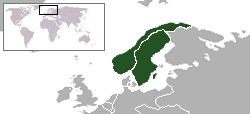
First of all, all those directly affected by this tragedy have my deepest sympathy. Sweden - my native country - and Norway were one country not too long ago (until the Union dissolved in 1905), and the two countries are still close. Our two languages are similar enough for us to understand each other without need for translation, and we share the geography of two stretched-out countries that lie side-by-side far to the north in Europe. Like all Swedes, I have several Norwegian friends.

Norway to the West, Sweden to the East. Wikipedia Commons.
When my grandparents up in the Jämtland region of central Sweden wanted to celebrate something or just feel a little fancy, they would dress up in their finest clothes and take the train or car a few hours West to Trondheim in Norway. There, they would eat a nice dinner at Palmehaven, the best restaurant in the small town. Then they would spend the night at Britannia Hotel (the town hotel in which the restaurant, by the way, was located) or return home the same day. I have a fond memory of joining them once, and remember the stunningly beautiful Norwegian scenery from the train window. So, like most Swedes, I feel a certain affinity to Norway and Norwegians.

A different but no less fond memory I have is of attending a youth politics summer camp in Sweden as a teenager. This has little to do with Norway, but a lot to do with the kind of camp at which the kids on Utöya were so savagely attacked. My camp was a truly wonderful, educational, inspirational, and simply fun experience. For me, it was a rare occasion to hang out with likeminded kids, who were as interested in the greater political world and in the power of ideas as I was. The camp was full of teenagers that believed - in the youthful manner that so many of us loose later in life - in the power to make the world a better place through democratic political action. We learned, debated, argued, swam, and had a lot of fun.

There was a lot of impressive brain power in that camp and a lot of heart. And we learned a lot, in many different ways. For example, everyone took turns helping an older kid who was rather severely disabled, with all his chores. I had never before helped someone my age who was unable to sit on a toilet go to the bathroom before, but I did so there, and I think I matured a little in the process of doing this and generally doing my part to help this boy for the duration of the camp, along with my friends. And I still remember the smart girl, a few years older than I, who explained to me the relation between European integration and the democratic deficit, which was a real revelation to me. These two random examples illustrate the range of intellectual and simply humane lessons we learned at the camp.

So it was 68 kids of the kind I was back then and of the kind of amazing friends I made at that camp, that Anders Behring Breivik murdered in cold blood on Utöya on July 22. This is also why this event has touched me so (I was physically nauseous for an entire day when I first heard about it and after browsing through his manifesto yesterday, I had nightmares all night). About these wonderful teenagers and children, he writes the following in his manifesto, emailed to his network of fellow Islamophobes only hours before his attack:
In many ways, morality has lost its meaning in our struggle. The question of good and evil is reduced to one simple choice. For every free patriotic European, only one choice remains: Survive or perish. Some innocent will die in our operations as they are simply at the wrong place at the wrong time. Get used the idea [sic]. The needs of the many will always surpass the needs of the few.
I hope we never, ever will get used to this idea. These children and teens were indeed innocent but they didn't just get in his way: they were of course, with unbearable cruelty, deliberately chosen and targeted by Breivik. And they didn't perish due to some imagined threat of Europe's Islamisation, as the quote and the rest of the manifest suggests they would if they don't choose the "right" side, but by the hand of a xenophobic and Islamophobic extremist.

This is all I can do at this point. There is another post waiting to be written about this mass-murderer's connections to more mainstream Islamophobia - the depiction of him as simply a lone lunatic seems wholly misleading after having skimmed through his manifesto (and also in light of the fact that the there is information that suggests that he had accomplices, link in Swedish). In many ways, he simply acted on all the hatred that already is out there, most of it online, albeit with a degree of callous and calculated cruelty that evidences a profound and pathological lack of empathy. And, given that Islamophobes from Pat Buchanan to Sweden Democrats are coming out in defense (that's right, your eyes did not just deceive you) of the ideas of one of the world's cruelest mass-murderers only days after the massacre, there is apparently a need to refute them.

But that post will have to wait as I can't bear another night of nightmares. In the meantime, I wish we could all respond by reaffirming precisely the values Breivik struck at on Utöya, but did not manage to extinguish: empathy and humanity.

Friday, July 15, 2011

Cyprus threats, possibilities

In the midst of all the warranted pessimism about the prospect of Turkish EU membership (see my posts one and two on the state of play for an account of the main hurdles right now), there are a few interesting things happening. Most of them are a mixture of good and bad things but there are some bright spots, from the Turkish point of view.

Most significantly, the Cyprus issue appears to be coming to a head. This for two reasons: First of all, the EU has, as most of you know, a rotating presidency where each member state is saddled with the (significant and quite challenging) task of heading the work of the European Council for six months. The Republic of Cyprus (or the Greek, southern part of the island) is an EU member and its turn is for the first time coming up in a year from now (July 2012).

To Turkey and Turkish Cyprus, this represents a serious threat and it may put added pressure on them to  achieve a solution to the long-lasting conflict, which has been a major road-block on Turkey's path toward EU membership. It seems the Turkish Cypriot president, Derviş Eroğlu feels the pressure: After a meeting with EU enlargement commissioner Stefan Fule yesterday, he told reporters  that
If the Greek Cypriot administration assumes the rotating helm of the EU as planned and before we could reach any agreement, [the] window of opportunity for a solution will close.
That would mean we would have lost 2012. The Greek Cypriots are set to vote in presidential elections in 2013, which means that that would be a lost year, too. The Turkish Cypriots cannot wait for years to get a settlement. In the end, patience has its limits.
And top Turkish officials likewise sense the urgency. Foreign minister Davutoğlu and EU minister Bağış have both recently threatened that Turkey-EU relations may experience a "freeze" if there is no solution to the Cyprus conflict come July of next year. And therefore, they are pushing for a rapid settlement. Davutoğlu cited in EurActiv:
"We hope to find a solution to the Cyprus problem by the end of the year, and hold a referendum in the early months of next year so that Cyprus can take on the presidency of the EU as a new state that represents the whole island," Davutoğlu said during a visit to the Turkish Cypriot enclave in the north of the island.
A problem in this context is that all the pressure would seem to be on Turkey and Turkish Cyprus, since the Republic of Cyprus would not really be harmed by assuming the EU Presidency even in the absence of a resolution to the conflict. The result is the same one-sided pressure that the EU applied in 2004, in a failed attempt to push Turkish Cypriots to accept a peace plan that the Greek Cypriots subsequently rejected.

But here is where the second reason that there seems to be some movement on the issue may come in: UN Secretary General, Ban Ki-moon, appears to be ready to remove UN blue helmets from the island unless there is movement soon. Here's former Dutch MEP, Joost Lagendijk:
On Cyprus, we have seen a new wave of enthusiasm over the last couple of days, even among skeptics who thought that the Cyprus problem would never be solved. This optimism is based on the talks that took place in Geneva last week in which United Nations Secretary-General Ban Ki-moon presented a plan for the completion of the talks between the Greek Cypriots and the Turkish Cypriots in October of this year. Many had given up hope that these negotiations would produce anything close to a solution. The UN chief has now made clear that he is not willing to accept failure or an endless dragging on.
Removing the UN troops that patrol the norther-southern border would would, in Lagendijk's words, "make the Greek Cypriots feel extremely uncomfortable." So there may be just the kind of pressure on both parties that is needed for movement towards a resolution to the conflict to be within the realm of the thinkable.

Another protracted conflict that stands in the way of Turkish EU accession is of course the Kurdish issue, and here there is both recent violence and hints of progress. The NYT reports today of a PKK attack yesterday, that left 13 Turkish soldiers dead, and of failed talks to end the parliamentary boycott by Kurdish MPs.

But, as The Economist notes,
secret talks between the government and Abdullah Ocalan, the imprisoned Kurdish PKK leader, continue despite Mr Erdogan’s anti-Kurdish tone during the campaign.
And apparently,
Mr Ocalan has suggested that a deal to bring an end to the PKK’s 27 years of insurgency might be within reach. 
Now, I teach courses ethnic conflict and wouldn't suggest that a lasting and comprehensive solution to a conflict as intractable as the Kurdish rebellion is an easy feat or that a settlement that is centrally negotiated with an imprisoned rebel leader is all that it would take. But it would certainly be a major coup for the Turkish government and a key ingredient in a lasting resolution of the conflict.

So, in the midst of all the pessimism, one could - I'm not saying that it is likely, just possible - one could imagine a scenario in which both of the two dragged-out and highly debilitating conflicts that have been used as key arguments against Turkish EU accession by innumerable EU politicians, are partially resolved within a year. This would certainly put the ball in the EU's court.

Wednesday, July 13, 2011

Football (soccer) corruption probe in Turkey

Watching the Swedish women's soccer team struggle against Japan (semi finals). Seems like a good time to note that while the Swedes are struggling on the field, Turkish soccer is struggling off the field with a massive corruption and game-fixing probe. The New York Times reports:
The presidents of Fenerbahce and Trabzonspor, who finished first and second in the Turkish Super League this May, are in jail. So is a former head of the Turkish football federation. They are among the more than 60 men rounded up in police raids during the past week.
More disturbingly, the probe was apparently just widened to include Beşiktas. That's just not OK.

Ping your podcast